
AI SearchOptimization for HVAC Companies
The engines already recommend somebody.
They build the answer from roundups and directories they trust, not from whoever ranks first, so a contractor can hold the top Map Pack slot and never be named. The work is measuring which prompts return you, then getting cited in the sources they read. Placements are verified live and rechecked thirty days later, and the report goes out whether an engine started citing you or not.
What AI search optimization for HVAC covers
What the group covers, and where it stops, before you pick one of the three services inside it.
AI search optimization for HVAC is the work of getting named when a homeowner asks an answer engine who to call, rather than typing a query into Google. It goes by several names, generative engine optimization and answer engine optimization among them, and the mechanics behind all of them are the same: an engine assembles its answer from sources it already trusts and from the entity record it holds about a business.
That makes it a different job from ranking. A contractor can hold the first Map Pack slot in their city and still never be named by ChatGPT, because the engine is reading Top 10 roundups, directories and structured data rather than the ranking order. The three services in this family cover the three parts of that: measuring which prompts return your name, earning citations in the sources the engines quote, and making the entity record unambiguous.
Want to know which prompts you are invisible for?
The report answers that in five days for $349, across ChatGPT, Perplexity, Claude and Google AI Overviews, with no call required.
How an answer engine decides who to name
An answer engine does not rank pages, it assembles an answer from sources it trusts: roundups, directories and the entity record it already holds about a business. So the work is getting cited in those sources and making the entity unambiguous, in that order, and knowing which prompts you are invisible for before you spend on either.
See the servicesThree GEO services, each with a price
Each one is bought on its own, at the price on the card. Nothing here is gated behind a call and nothing here needs a retainer.
Which AI search service to buy first
The order matters more than the total spend. Bought in the wrong order, two of these pay for work the third has to redo.
01
Measure the prompts, not the keywords
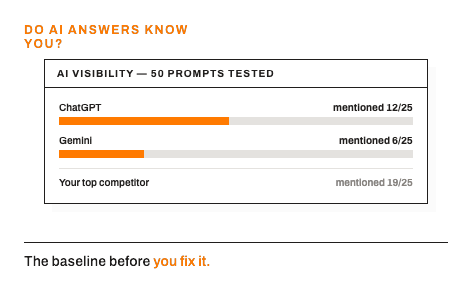
Which questions a homeowner actually asks an engine in your city, and which of them return your name. Almost every contractor starts at zero across all four engines, and that baseline is what everything else is measured against.
02
Get cited in the sources the engines quote
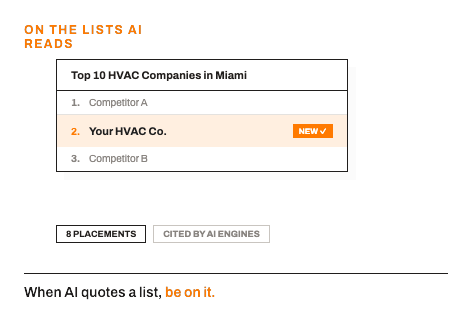
The Top 10 lists and local roundups the engines actually pull from, each placement earned on a real publication, handed over as a live URL and rechecked thirty days later.
03
Make the entity impossible to confuse
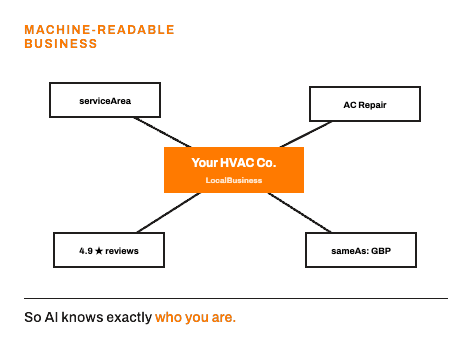
One connected graph with stable identifiers, so the same business is not read as three different companies across the site, the profile and the citations.
What generative engine optimization costs
Entry prices in this family run from $349 to $1,200, one-time, with the exact number on every card above and in the service agreement before anything starts.
The report is the only thing here anybody should buy first. It is the cheapest item in the family and it is what tells you whether the other two are worth the money in your city.
The words this page uses
Answer engine optimisation
Work aimed at being named by ChatGPT, Perplexity, Gemini and AI Overviews, which assemble answers from third-party lists and structured data rather than ranking pages.
Schema @graph
A single connected block of structured data where every node references the others by a stable identifier, instead of isolated blocks repeated per page.
The questions contractors actually ask
Answered straight, including the ones where the answer is no.
Is this not just SEO with a new name?
No. The overlap is real but partial: an engine assembles an answer from lists and entity data rather than from the ranking order, so a contractor can be first in the Map Pack and never get named by ChatGPT. That is exactly what the report measures.
Can you guarantee ChatGPT starts recommending me?
No, and anybody who does is selling something they cannot control. We guarantee the placements, verified and live, and the entity work. Whether an engine starts citing them is the engine's decision, and we recheck and report it either way.
Where do I start?
The AI Visibility Report. It costs $349, takes five days, and tells you which prompts you are invisible for. Buying placements before that is buying blind.
Does this replace local SEO?
No. Answer engines lean on the same citation and review record that the Map Pack does, so the two families reinforce each other. If you have to pick one first, pick the one where the calls are coming from today.